
Christians for Armenia · Reformed Faith and Life
Modern Eastern Armenian Bible Translation Project
Completion and printing of the translation
A faithful translation from the Hebrew, Aramaic and Greek source texts, for contemporary Eastern Armenian readers.
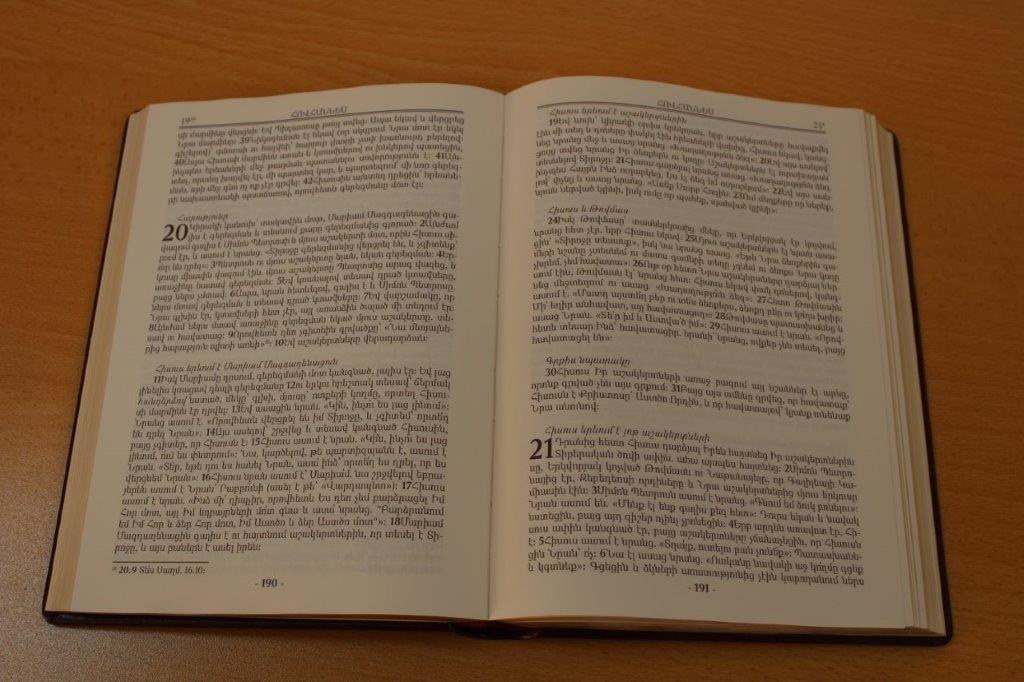
The new Eastern Armenian translation of the New Testament and Psalms.
Why this project is needed
The absence of a faithful translation of the Bible into contemporary Eastern Armenian, made directly from the Hebrew and Greek source texts using recent scholarly editions, has made access to Holy Scripture difficult for speakers of this language.
Most existing versions are revisions of earlier versions derived over the centuries from the ancient fifth-century “Grabar” translation. The Old Testament was translated mainly from the Septuagint (LXX), and the New Testament probably from the Peshitta, in Aramaic, although opinions differ on this point. The oldest known manuscript is a copy of the four Gospels, transcribed in AD 887.
These ongoing revisions, presented to the public as “new translations”, often contain inaccuracies when compared with the original sources. Their language is also frequently difficult for contemporary readers to understand because of numerous archaisms. Moreover, official versions include the deuterocanonical books of the Old Testament on the same footing as the canonical Hebrew writings. Other versions take English translations, such as the King James Version, as their starting point, or rely on modern English paraphrases to achieve a more accessible style.
A new and sound approach to translating the Bible into modern Eastern Armenian was therefore needed. This approach, widely accepted in international Bible translation projects, uses the best currently available editions of the Hebrew and Aramaic texts for the Old Testament and the Koine Greek text for the New Testament.
Source texts
For the Old Testament, the fourth edition of the Biblia Hebraica Stuttgartensia (BHS, Deutsche Bibelgesellschaft, Stuttgart, 1990) was chosen, since the complete fifth edition, Biblia Hebraica Quinta, has not yet appeared, although several fascicles are already available. The BHS is based on the Codex Leningradensis, B 19A (L), the oldest dated manuscript of the complete Hebrew Bible, copied in Cairo in AD 1008.
For the New Testament, the 28th edition of the Nestle-Aland Greek-English New Testament, with the ESV in parallel, serves as the base text. The complete New Testament translated into Western Armenian in 2005 by Pastor A. R. Kayayan is used as a reference. That translation was made from the Greek text of the third United Bible Societies edition, edited by K. Aland, M. Black, M. Martini, B. Metzger and A. Wikgren.
Other resources
Reformed Faith and Life – Christians for Armenia (RFL-CFA) has provided a team of Armenian translators with standard Hebrew and Greek exegetical dictionaries, as well as classic biblical commentaries that were not available in Armenia before this translation project began around twenty years ago. They also receive advice from qualified specialists based outside Armenia whenever additional help is needed.
Translation aims
This new translation seeks to give contemporary Eastern Armenian readers a faithful rendering of the Greek and Hebrew source texts mentioned above, in a clear and elegant style that does justice to the original meaning of words and expressions. It must avoid any form of paraphrase. Drawing on the flexibility of Eastern Armenian, it aims to express the rich nuances of the Bible’s original languages, retaining “Grabar” words wherever they are not archaic for contemporary readers. The translators remain in close contact with the Eastern Armenian language editor-in-chief to ensure the suitability of their lexical choices. All acceptable alternatives within the stated aim of fidelity to the source texts are considered through a thorough consultation process.
As a guideline, the translators have received the joint statement on basic principles and procedures for Bible translation, unanimously adopted by all member organisations of the Translation section of the Forum of Bible Agencies at their meeting on 21 April 1999 (http://www.bible-researcher.com/fba-guidelines.html).
In summary, the project aims to produce a clear, source-faithful translation of the New Testament and Psalms into Eastern Armenian, suitable for readings during church services, catechism instruction, Bible studies and personal use.
Explanatory notes
The translators have added explanatory notes to clarify certain translation questions, rather than theological issues, and to offer alternative readings where necessary. Two substantial introductions will precede the Old and New Testaments, setting out the historical and revelatory framework that underlies the unity of Scripture throughout the biblical writings.
Expected schedule
The New Testament and Psalms were completed and published in 2022, with 6,000 copies printed in Yerevan, Armenia. They are being widely distributed to the public free of charge. Churches and individual readers have welcomed this volume for its literary clarity and clear layout.
Translation of the Old Testament is well advanced, with completion scheduled for the end of 2027. A detailed work schedule has been established for the remaining books, together with a translation budget for each one. Publication is envisaged for late 2028 or early 2029, allowing a full year for editing and preparation.
Printing budget
A minimum print run of 25,000 copies is planned. Printing costs are estimated at US$11 per copy, based on current prices and the exchange rate between the US dollar and the Armenian dram in May 2026. Reformed Faith and Life has already allocated US$150,000 and is seeking a further US$125,000 to reach this minimum target. RFL-CFA aims to distribute the printed copies so that the Word of God reaches as many Armenians as possible, both in the Republic of Armenia and in neighbouring countries: Georgia, the Russian Federation and Iran.
Contact
For more information, or to subscribe to our quarterly newsletter, please contact:
Pastor Eric Kayayan (RFL-CFA president): erickayayan@gmail.com
Reverend Peter Adams (RFL-CFA vice-president): peteradams@juno.com
Cheques for donations to the Bible translation project may be sent to:
Reformed Faith and Life – Christians for Armenia
P.O. Box 8208
Kentwood, MI 49508
United States